The Brazilian orange crop for Marketing Year (MY) 2025/26 is forecast at 330 million 90-pound boxes (MBx) – standard reference, equivalent to 13.5 million metric tons (MMT), an increase of 3.7 percent compared to previous Post estimate (320 million boxes or 13 MMT), primarily due to satisfactory weather conditions expected in 2026. Post forecasts the Brazilian FCOJ 65 Brix equivalent production in MY 2025/26 at 1.03 MMT, an increase of 1.86 percent from Post’s revised estimate for MY 2024/25 (1.01 MMT).
FRESH ORANGES
PS&D Table
The following table provides data for Brazilian fresh orange production, supply, and distribution (PS&D) for Brazilian (BR) marketing years (MY, July-June) 2024/25, 2025/26, and 2026/27. The MY mentioned above are equivalent to U.S. MY 2023/24, 2024/25, and 2025/26, respectively.

Production
Post forecasts the total Brazilian orange crop for MY 2025/26 (July/June) at 330 million 40.8-kg boxes (MBx) – standard reference equivalent to 90 pounds – or 13.5 million metric tons (MMT). This is an increase of 3.7 percent compared to the Post estimate for MY 2024/25 (320 million boxes or 13 MMT), due to satisfactory weather conditions expected in 2026.
According to Post contacts, despite the incidence of greening, MY 2025/26 crop is projected to perform well, especially if orchards benefit from milder temperatures, with little expected variation.
The citrus belt, which is composed of the northwest of São Paulo state and the western part of Minas Gerais state, known as “Triângulo Mineiro”, is the main production region in Brazil. The MY 2024/25 orange crop forecast for the citrus belt, released on December 10, 2025, by Fundecitrus in collaboration with FCAV/Unesp, projects total production at 294.81 million boxes (40.8 kg each). Of this total, approximately 26.93 million boxes are expected to be produced in the Triângulo Mineiro region.
According to Fundecitrus, the MY 2024/25 orange harvest began with two primary blooms, with the second bloom playing a critical role in crop development. Below-average rainfall and slower fruit maturation marked the early months, but conditions improved by late 2025, enhancing fruit quality, Brix-to-acidity ratios, and sensory attributes of the juice. While greening remains a concern, the outlook for production quality is increasingly positive.
From May to November 2025, total rainfall in the citrus belt reached 392 mm, 20 percent below the 1991–2020 average. According to Fundecitrus, the citrus belt experienced drier-than-normal conditions during the first nine months of 2024, a period critical for orange tree flowering. During this period, accumulated rainfall was 55 percent below average, resulting in insufficient soil moisture for non-irrigated groves to induce flowering.
In Brazil, approximately 20 percent of orange production is sold as fresh fruit (in natura), while the remaining 80 percent is processed for juice. The main orange varieties that Brazil produces are Hamlim, Westin, Rubi, Valencia Americana, Seleta, Pineapple, BRS Alvorada, Pera Rio – pear orange, Valencia, “Folha Murcha” Valencia, and Natal.
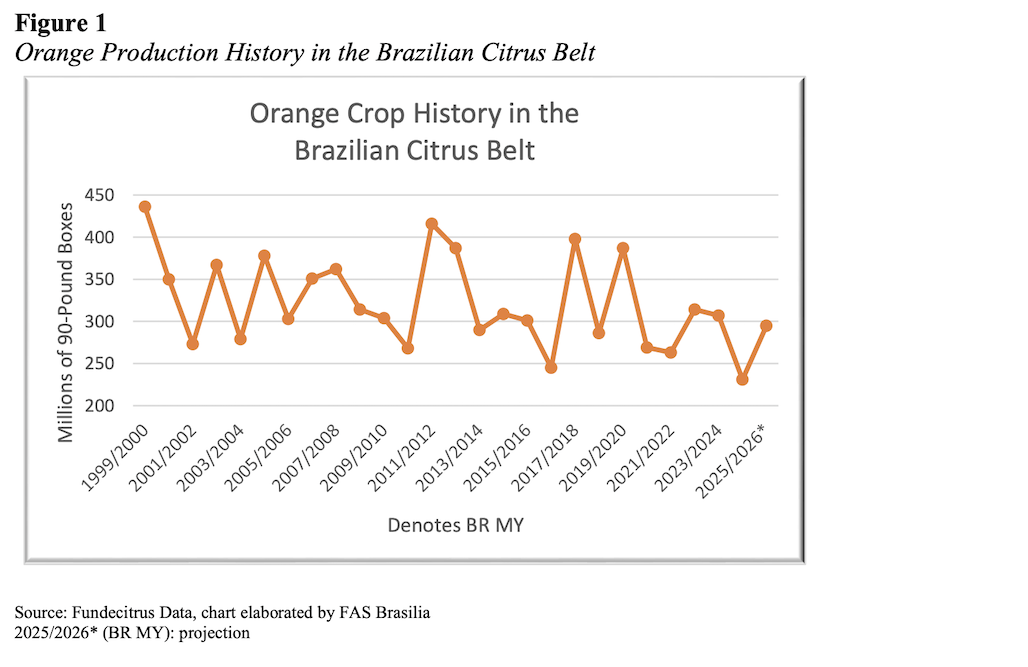
Figure 1 shows the history of orange production in the Brazilian citrus belt, reflecting significant oscillations over the course of twenty-five years. Production ranged from 436 million 40.8-Kg/90-pound boxes (18.36 MMT) in BR MY 1999/2000 to the estimated 294 million (12 MMT) BR MY 2025/26, aprojected decrease of 32 percent from the previous harvest (BR MY 2024/25), due to fruit drop and reduction in size. Nevertheless, Post contacts indicate the current harvest is the largest since 2020.According to the latest estimates from Fundecitrus, the average weight of fruit is 4 grams lower than projected in September. As a result, the number of oranges required to fill a 40.8 kg box has increased from 258 (158 g/5.57 oz each) to 265 (154 g/5.43 oz each).
The southwest region (Itapetininga and Avaré) leads with 1,103 boxes/hectare, up 23 percent from last season, likely maintaining top status, according to Fundecitrus. The most challenging area is northwest region (Votuporanga and São José do Rio Preto), with low yield at 552 boxes/hectare, still 16 percent above previous levels. The north region experienced the highest change, at 41.8 percent.
September 2025 rainfall in key citrus regions of São Paulo and Minas Gerais helped induce flowering in certain orchards, but the volume remained insufficient to offset the ongoing water deficit. October 2025 rains begun improving conditions for orange trees and preparing them for next season’s blooms, according to the Center for Advanced Studies on Applied Economics (Cepea). Mid-season oranges, which are essential for the juice industry, were previously in high supply. However, concerns about fruit drop may limit the total harvest volume for the MY 2024/25 (BR MY 2025/26) season.

A recent NOAA report indicates that although La Niña is currently weak, it is expected to continue influencing Brazil’s climate through early summer 2025. The phenomenon will likely bring increased rainfall to the Center-West and Southeast regions, milder temperatures along the coast, and more frequent storms. In contrast, the South is expected to experience variable, but not extreme, weather conditions.
According to Post contacts, weather conditions in 2025 were generally stable, which supported strong crop production. However, the citrus belt faces ongoing dry spells, heat waves, and rising temperatures from La Niña, expected to last until March 2026. The past five years have also seen high temperatures, with 2026’s outlook depending on La Niña’s strength.
By mid-2026, the likelihood of El Niño – typically associated with hotter weather and irregular rainfall in Brazil – begins to rise, potentially becoming dominant in 2027. This could significantly alter rainfall patterns and temperatures, making it essential for Brazilian farmers and to monitor updates and prepare for possible climate extremes.
Climatempo reports that rainfall in Brazil’s citrus belt from May to August 2025 averaged 94 mm, 33 percent below the historical average (1991-2020), except in São José do Rio Preto, which saw 21 percent above-average precipitation. Despite this, April and June rains provided sufficient soil moisture, keeping the weight of early varieties like Hamlin, Westin, and Rubi stable at 134 g (305 fruits per box). Within the citrus belt regions, in 2025, only Porto Ferreira exceeded historical rainfall levels; all other regions fell short. The North experienced the steepest declines, with deficits between 32 percent and 47 percent. São José do Rio Preto and Brotas saw drops of 21 percent, followed by Matão and Duartina (18 percent), Avaré (17 percent), Itapetininga (15 percent), Votuporanga (11 percent), and Limeira (6 percent).
Exports
Post forecasts Brazilian FCOJ 66 Brix equivalent exports in MY 2025/26 at 973,276 MT, a slight increase of 2 percent compared to Post estimate for the previous crop (953,840 MT). According to Post contacts, the country is exploring new markets in Europe, as well as the People’s Republic of China (PRC), with a slight presence already in place. There are a few projects and campaigns from the Brazilian Trade and Investment Promotion Agency (Apex) already underway to promote the Brazilian orange juice to other markets, such as “Orange Juice, a good choice”; and the IFU Juice Conference.
Organized by the International Fruit and Vegetable Juice Association (IFU) in partnership with CitrusBR, the event brought together Brazilian business leaders and international buyers from over 28 countries. ApexBrasil was the official sponsor of the 2025 edition, which hosted around 250 participants and served as a key platform for business development, networking, and strengthening Brazil’s presence in the global juice market.
Brazil is the world’s largest supplier of concentrated juice, remaining capable of large-scale production, despite oscillations in production. The country plays a crucial role in meeting U.S. demand, as 80 percent of the orange juice consumed in the U.S. is imported, primarily from Brazil and Mexico. This reliance has grown due to Florida’s declining citrus production, driven by the spread of greening disease (HLB).
The European Union (EU) remains the dominant market for Brazilian orange juice. However, there is a downward trend over the period. Exports to the EU decreased from 654,098 MT in MY 2019/20 to. MY 2025/26 161,413 MT so far in MY 2025/26.
Exports to the U.S. fluctuated but generally remained robust, peaking at 340,736 MT in MY 2021/22. Since then, there has been a gradual decline, with 309,668 MT exported in MY 2023/24 and 161,958 MT in the partial MY 2025/26. Despite the decrease, the U.S. continues to be a critical destination for Brazilian orange juice, due to its large consumer base and established trade relationships.
— By USDA Foreign Ag Service Brazil and Carolina Castro